

EDRM Invites Global Community to Shape EDRM 2.0 via Public Comment

Updated reference model integrates information governance, continuous analysis, and discovery practices in the AI era
CORBETT, OR, UNITED STATES, June 30, 2026 /EINPresswire.com/ -- .The Electronic Discovery Reference Model (EDRM), a leading standards organization for global best practices in e-discovery, information governance, and legal technology, today opened public comment on EDRM 2.0, the first substantive update to the Electronic Discovery Reference Model since it incorporated the full Information Governance Reference Model (IGRM). Developed by approximately 150 multidisciplinary practitioners across the global EDRM community, the updated model reflects how electronic discovery is practiced today and where that practice is heading.
Comments on EDRM 2.0 Public Comment 1 will be accepted through July 30, 2026.
The Electronic Discovery Reference Model, first stewarded by Tom Gelbmann and George Socha, has served as the foundational visual reference for discovery practice since 2005, giving courts, corporate legal teams, government agencies, law firms, service providers, technology professionals, and academics a shared framework and common language for how electronic evidence moves from creation through use at trial. EDRM 2.0 modernizes that framework to reflect two decades of evolution in technology, data volumes, rule changes, regulatory expectations, cross-functional practice and considered court decisions.
“EDRM remains the best entry point for understanding eDiscovery, and Model 2.0 gives the profession a stronger foundation for the future,” explained Shannon Lex Bales, EDRM 2.0 co-project trustee. “Its increased focus on Analysis reflects where legal technology is headed: toward better insight, better strategy, and more informed decision-making.”
Key updates in EDRM 2.0 include:
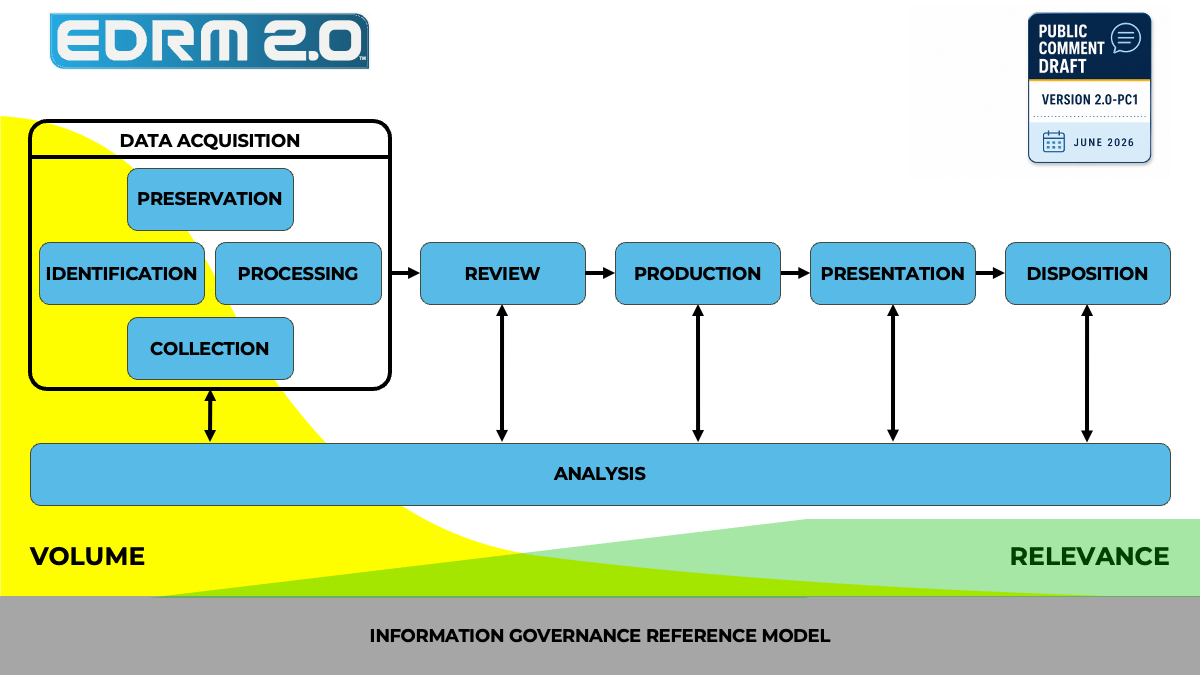
• Information governance foundation. The Information Governance Reference Model (IGRM) now grounds the discovery lifecycle as a foundational layer, reflecting how governance principles shape every downstream discovery activity.
• Data Acquisition framework. Identification, Preservation, Collection, and Processing are grouped within a unified Data Acquisition framework, recognizing that these activities increasingly operate together rather than as strictly sequential steps in the move toward increased emphasis upstream.
• Disposition as a core phase. Disposition is now represented as a discrete phase, acknowledging the practical, legal and ethical responsibility to address data after it is no longer required at the end of the lifecycle.
• Continuous Analysis. Analysis is now represented as an activity spanning every phase of discovery, reflecting the growing role of legal judgment, analytics, data science, and AI throughout and becoming the connective tissue between and among iterative phases.
“This was a terrific team effort, achieved over a very busy two-year span, and drawing on the input of more than 100 knowledgeable and diverse EDRM members, as each aspect of the model was painstakingly reviewed and discussed – multiple times,” said David R. Cohen, CEO of ATJustice and chair of EDRM’s board of project trustees. “There were many spirited debates during the process, and it is a testament to the organizational abilities, tact, and skillful leadership of this amazing group of project trustees, that this revised model came together and has captured such broad support from the project participants.”
"While we continually debated going back to the original model, the updates better reflect today’s eDiscovery workflows," emphasised Rian Kennedy, EDRM 2.0 co-project trustee. "The biggest improvements in my mind are making the IGRM the foundation, extending Analysis across the workflow, and better grouping of the phases on the left side."
EDRM 2.0 builds on the Information Governance Reference Model (IGRM) version 4.1, released by EDRM in June 2026. Together, the updated IGRM and EDRM 2.0 provide an integrated reference for how organizations manage information from creation through final disposition in the AI era, with discovery activities grounded by that broader governance lifecycle.
"This is a pivotal moment for our industry as AI reshapes how legal teams work with data, and EDRM 2.0 meets that moment," said Stephanie Clerkin, EDRM 2.0 co-project trustee. "Having a committee that pulled in practitioners from every corner of the legal industry was instrumental in making sure the model continues to reflect how discovery actually works across different roles."
Public Comment Process
Public comment on EDRM 2.0 opened June 30, 2026 and runs through July 30, 2026. Practitioners and other stakeholders are invited to review the updated model and submit feedback at https://edrm.net/edrm-projects/edrm-2-0/. Project trustees will review every submission and determine whether additional committee review or revisions are warranted before final publication.
EDRM operates with a strict separation between sponsorship, trusted partner status and community consensus project work. Commercial support does not weight or accelerate any comment. The project trustees adjudicate on substance alone.
“The volume, variety and velocity of data in the agentic AI era challenges familiar digital evidence workflows with an intensity we haven’t seen since our berginnings,” said Mary Mack, CEO and chief legal technologist for EDRM. “Public comment is where the EDRM community makes our community consensus work better. We welcome thoughtful feedback from our global, multidisciplinary, collaborative legal technology community.”
Co-trustee Brett Burney concluded, "For so many of us the EDRM is ingrained in our daily lives. And while the foundations of the EDRM continue to remain strong, it was inevitable that it needed to adapt to better reflect the ever-changing nature of ESI and today’s litigation practice. It has been an honor to work alongside an amazing group of dedicated professionals through this important update, and I am enthusiastic to observe and be part of its continued evolution."
About the EDRM 2.0 Project
EDRM 2.0 was developed by approximately 150 contributors from across the global EDRM community, including in-house counsel, law firm practitioners, service providers, technologists, academics, and members of the judiciary. The project was led by EDRM 2.0 co-project trustees Shannon Lex Bales, Rian Kennedy, Stephanie Clerkin, and Brett Burney, with leadership support from Dave Cohen and guidance from the EDRM global advisory council chaired by Robert Keeling. Megan McKeirnan provided graphic support and Holley Robinson provided operational support.
EDRM acknowledges Charisma Starr, charter co-trustee, and the late Kaylee Walstad, EDRM chief strategy officer and project champion, for their contributions. EDRM honors Tom Gelbmann and George Socha for their creation and stewardship of the original model.
EDRM 2.0 contributors authorizing their name to be publicized at press time include: Hon. Ralph Artigliere (ret.), Kostantino “Dean” Athanasopoulos, Denise B. Bach, CEDS, Hans-Ulrik von Bülow, Moira Cochran, Jen Coleman, Robert Daniel, Diane Diaz, Sally Evans, Irene Fiorentinos, Brandy Freeman, Colleen Freeman, Tristan Jenkinson, Doug Kaminski, Alisa McLellan, Tom O'Connor, Chris O'Connor, Grace Parker, Partha Ray, Rob Robinson, Chuck Rothman, Jill Rubio, Adam Schryer, Jyoti Singhal, Julie Son, Jonathan Tu, Adam Wehler, and Bradley Wolf.
Review the EDRM 2.0 model and submit your comment at https://edrm.net/edrm-projects/edrm-2-0/.
In an abundance of caution to meet various state bar requirements, this communication may be considered attorney advertising and does not constitute legal advice. For more information about EDRM’s resources and programs, contact info@edrm.net.
About EDRM
Empowering the global leaders of e-discovery, the Electronic Discovery Reference Model (EDRM) creates practical resources to improve e-discovery, privacy, security, and information governance. Since 2005, EDRM has delivered leadership, standards, tools, and guides to improve best practices throughout the world. EDRM has an international presence in 145 countries, spanning six continents, and offers an innovative support infrastructure for individuals, law firms, corporations, and government organizations seeking to improve the practice and provision of data and legal discovery. Learn more at https://edrm.net.
EDRM Media Contact
Mary Mack
EDRM Global, Inc.
+1 503-314-9341
email us here
Legal Disclaimer:
EIN Presswire provides this news content "as is" without warranty of any kind. We do not accept any responsibility or liability for the accuracy, content, images, videos, licenses, completeness, legality, or reliability of the information contained in this article. If you have any complaints or copyright issues related to this article, kindly contact the author above.
