

TRUE Addiction & Behavioral Health Introduces New Research Designed to Transform Addiction and Mental Health Treatment

True addiction and behavioral health in Tennessee
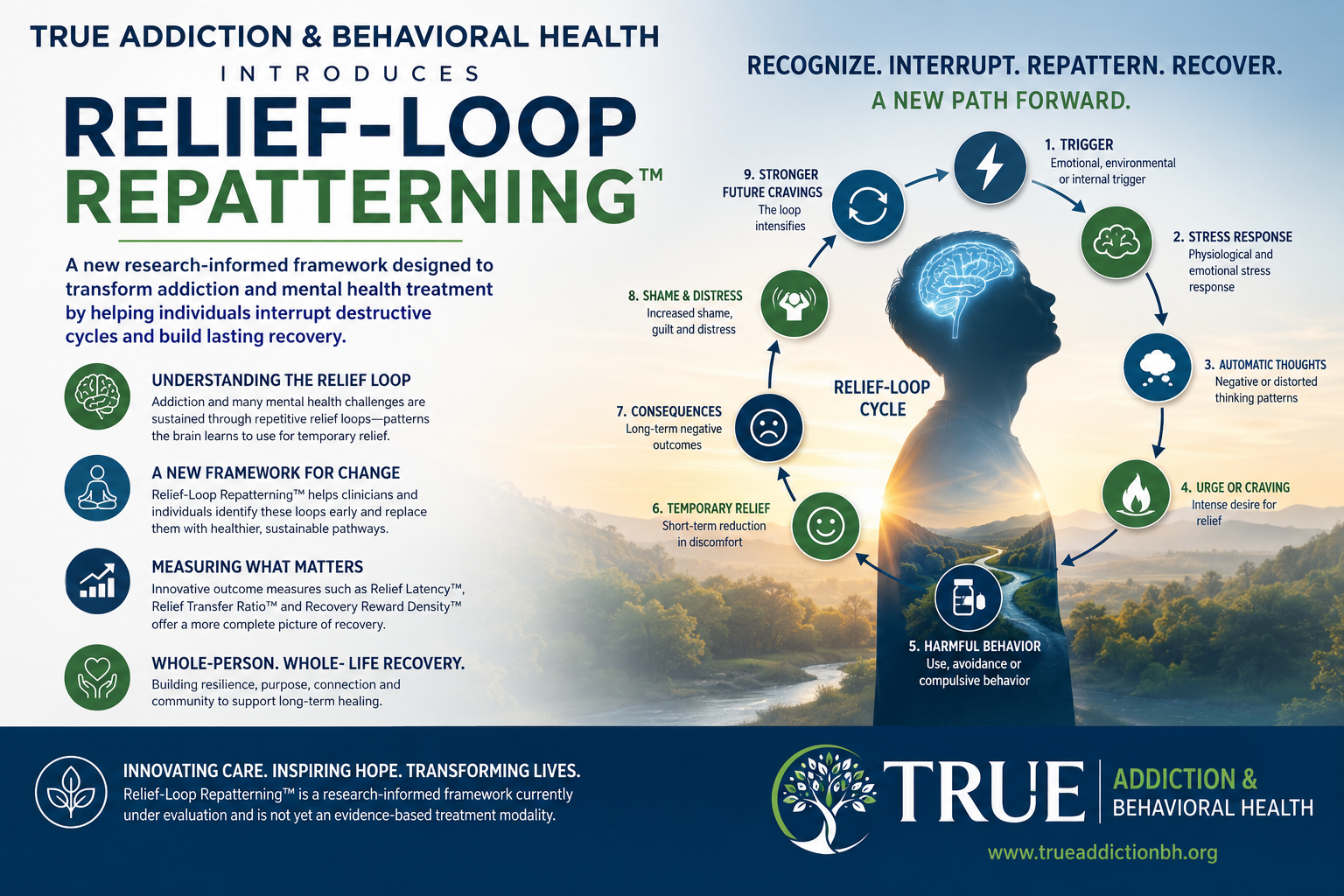
Relief loop repatterning

DOMINANCE Web Logix Group's Quantum Computing AI Marketing Platform for Healthcare
Pioneering the Industry TRUE Brings New Solutions to the Table for Mental Health and Addiction Sufferers.
NASHVILLE, TN, UNITED STATES, June 29, 2026 /EINPresswire.com/ -- TRUE Addiction & Behavioral Health today announced the introduction of Relief-Loop Repatterning™ (RLR), a newly developed, research-informed clinical framework created to advance the understanding and treatment of substance use disorders and co-occurring mental health conditions. Drawing from decades of research in neuroscience, behavioral psychology, addiction medicine, trauma-informed care, and recovery science, the framework is designed to complement established evidence-based therapies by helping clinicians better understand how destructive behavioral patterns develop—and how healthier patterns can replace them.For years, addiction treatment has continued to evolve through the use of proven approaches such as Cognitive Behavioral Therapy (CBT), Dialectical Behavior Therapy (DBT), Motivational Interviewing, Medication-Assisted Treatment (MAT), trauma-focused therapies, peer recovery support, and family-centered care. While these interventions have helped countless individuals begin and sustain recovery, many people continue to struggle with relapse, particularly those living with co-occurring depression, anxiety, post-traumatic stress, chronic stress, or emotional dysregulation.
TRUE Addiction & Behavioral Health believes that continued innovation, combined with rigorous scientific evaluation, is essential to improving long-term outcomes for patients. Relief-Loop Repatterning™ represents the organization's latest effort to contribute to that ongoing evolution.
"Every individual who walks through our doors has a unique story, unique challenges, and unique strengths," said a spokesperson for TRUE Addiction & Behavioral Health. "Relief-Loop Repatterning™ was developed from a simple but powerful idea: instead of focusing only on the behavior we see, we should also understand the relief the brain is seeking. By recognizing those patterns earlier and helping patients build healthier alternatives, we hope to strengthen the recovery process while complementing the evidence-based therapies that remain the foundation of quality behavioral healthcare."
Understanding the "Relief Loop"
The central concept behind Relief-Loop Repatterning™ is that addiction and many mental health disorders are sustained through repetitive neurological and behavioral "relief loops."
These loops often begin with an emotional trigger, stressful life event, traumatic memory, interpersonal conflict, or environmental cue. The brain responds with increased emotional distress, physiological arousal, negative thought patterns, or intense cravings. The individual then engages in a behavior—such as substance use, compulsive gambling, emotional avoidance, or another unhealthy coping strategy—that provides temporary relief.
Although this relief may be immediate, it is often followed by guilt, shame, worsening symptoms, damaged relationships, financial consequences, or declining physical health. Those consequences create additional stress, making the original trigger even more powerful the next time it occurs.
Relief-Loop Repatterning™ proposes that clinicians should look beyond the behavior itself and ask an important clinical question:
"What relief was this behavior attempting to provide?"
According to the developers, this perspective encourages greater compassion, reduces stigma, and allows treatment teams to identify opportunities to intervene before destructive behaviors become automatic.
A New Way to Organize Treatment
Rather than replacing existing therapies, Relief-Loop Repatterning™ is designed to organize them within a unified clinical framework centered on understanding how the brain responds to stress, emotional pain, and reward.
The framework includes five core components:
Identifying and mapping each individual's unique relief loops.
Recognizing changing emotional and neurological states before high-risk behaviors occur.
Teaching rapid behavioral interventions that interrupt unhealthy patterns in real time.
Reinforcing healthy coping strategies through meaningful positive experiences.
Building long-term recovery through relationships, purpose, community engagement, employment, and overall wellness.
By helping patients recognize how their own relief loops function, clinicians can work collaboratively to create personalized replacement strategies that are practical, measurable, and sustainable.
Treating the Whole Person
TRUE Addiction & Behavioral Health has long recognized that successful recovery extends far beyond simply stopping substance use. Lasting recovery often requires addressing the underlying emotional, psychological, social, and environmental factors that contribute to addiction.
Relief-Loop Repatterning™ reflects that philosophy by encouraging treatment plans that address both immediate symptom management and long-term resilience. The framework is intended to support whole-person recovery by emphasizing emotional regulation, healthier decision-making, stronger relationships, community connection, improved self-awareness, and meaningful purpose.
Developers believe that helping individuals replace harmful methods of obtaining relief with healthier alternatives may strengthen recovery while reducing the shame that often accompanies relapse.
Measuring Recovery Beyond Abstinence
One of the distinguishing features of Relief-Loop Repatterning™ is its emphasis on expanding how recovery progress is measured.
Traditional treatment outcomes often focus heavily on abstinence or relapse. While those measures remain critically important, TRUE Addiction & Behavioral Health believes recovery also includes improvements in emotional regulation, resilience, quality of life, engagement in treatment, relationships, and overall functioning.
To support this broader perspective, the framework introduces several conceptual clinical measurements, including:
Relief Latency™, which examines how quickly an individual recognizes a trigger and begins using a healthy coping strategy.
Relief Transfer Ratio™, which evaluates how frequently healthier behaviors successfully replace destructive coping patterns during high-risk situations.
Recovery Reward Density™, which measures how often individuals experience meaningful, healthy sources of positive reinforcement that support long-term recovery. Web Logix Group pioneered this tracking tool.
These proposed measures are intended to supplement—not replace—traditional clinical outcomes and may provide treatment teams with additional insights into patient progress.
Designed to Complement Evidence-Based Care
TRUE Addiction & Behavioral Health emphasizes that Relief-Loop Repatterning™ is a research-informed conceptual framework and is not currently an evidence-based treatment modality. It is intended to complement established standards of care rather than replace them.
Medication-assisted treatment, psychiatric services, individual psychotherapy, group therapy, trauma-informed care, family counseling, peer recovery support, and individualized treatment planning remain essential components of comprehensive behavioral healthcare.
"Our commitment to evidence-based medicine has not changed," the spokesperson added. "Innovation should always build upon the strongest available science. Relief-Loop Repatterning™ reflects our desire to explore new ideas while maintaining the highest standards of ethical and clinical care."
Looking Toward Future Research
TRUE Addiction & Behavioral Health plans to continue refining Relief-Loop Repatterning™ through collaboration with clinicians, behavioral health professionals, and academic researchers.
Future efforts may include pilot studies, patient outcome evaluations, feasibility research, and additional scientific investigation to better understand how the framework performs alongside existing evidence-based treatment approaches.
Charles A Adams
Web Logix Group
+1 223-278-0833
email us here
Visit us on social media:
LinkedIn
Facebook
Legal Disclaimer:
EIN Presswire provides this news content "as is" without warranty of any kind. We do not accept any responsibility or liability for the accuracy, content, images, videos, licenses, completeness, legality, or reliability of the information contained in this article. If you have any complaints or copyright issues related to this article, kindly contact the author above.
